Upcoming ETFs, evolving indexes to mark new chapter for crypto investing
Hashdex CIO says firm’s crypto index fund could one day hold 200 assets

Artwork by Crystal Le
Now’s as good a time as any to talk crypto ETFs as more US launches are imminent (even with the latest government shutdown).
The anticipated boom of both single-asset and index offerings is set to expand the investor base entering the crypto asset class, industry watchers say.
How do we know we’re set to see more crypto ETFs flood the US market? For one, the SEC finalized its generic listing standards. Those, as you might recall, are set to streamline approvals as long as an ETF proposal meets various spelled-out requirements.
There are roughly a dozen crypto assets the agency appears ready to allow in the ETF wrapper, per the guidelines — litecoin and solana among them.
A person familiar with the filings told me earlier this month that solana ETF amendments were due Sept. 26. They weren’t kidding.
It’d be fair to say the SEC is most focused on the solana ETF proposals right now, another person close to the filings told me Tuesday.
Perhaps we’ll see some more amendments, though the S-1s look pretty close to ready. And reports of various 19b-4s soon being withdrawn make sense given exchanges wouldn’t need a rule change to list ETFs holding assets fitting the new standards.
It’s worth noting that 19b-4s could still be filed for proposed ETPs holding assets that fall outside the generic listing standards.
And it’s possible too for the standards to evolve over time. Perhaps, some believe, to not necessarily require an asset to have a regulated futures market — and/or to include prerequisites based on token-specific data.
Whether we are weeks away (or mere days) from the solana ETFs launching remains to be seen. Several issuers are essentially ready to launch, but hesitant to speculate on exactly when the SEC will sign off. Bitwise CIO Matt Hougan told Blockworks’ own Katherine Ross we could see multiple new crypto ETFs by Halloween.
But beyond timing, what should we expect from investor demand?
Well, US bitcoin ETF inflows stand at $57.3 billion. Ether ETFs have so far attracted $13.7 billion. That inflow difference more or less corresponds to the market caps for BTC (~$2.2 trillion) and ETH (~$500 billion).
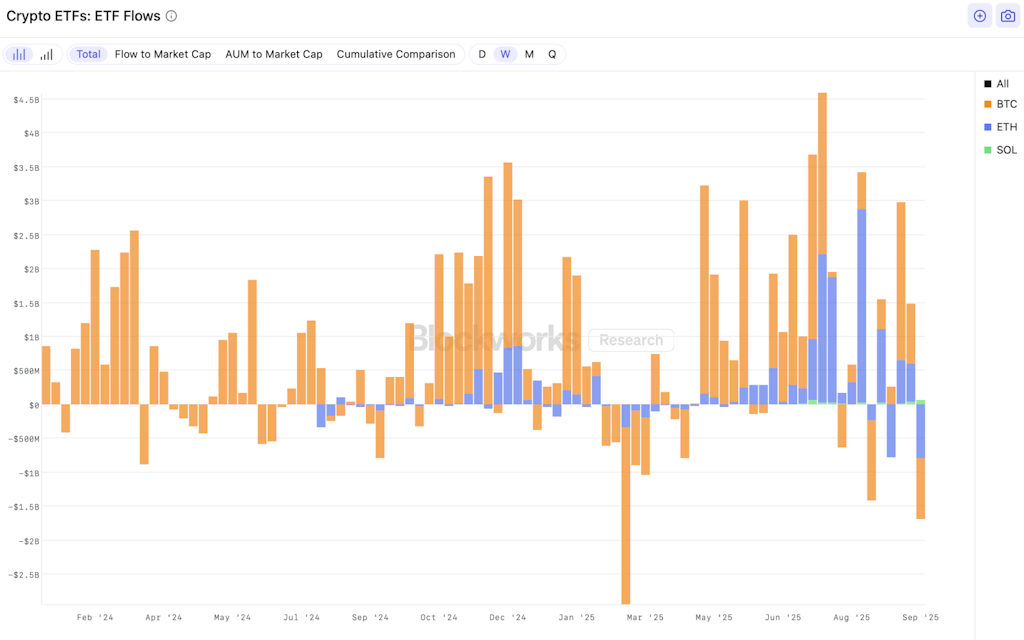
As far as the demand for any new US crypto ETFs that launch, ETF.com analyst Sumit Roy said assuming the flows will be proportional to market cap is a good starting point.
“But the new coins may actually underperform compared to that,” he added. “That’s because BTC, and to a lesser extent, ETH, are benefiting from asset allocation flows from certain investors [who say], ‘I’ll put 2% of my portfolio in bitcoin as a diversifier/hedge.’”
While coins (excluding ETH) won’t see those flows initially, Roy argued, they may eventually benefit if crypto index funds take off in a bigger way.
“Right now, index funds are small relative to funds that hold single assets like BTC,” he said. “If that ever changes, then the flows could be more widely distributed.”
A new phase of crypto investing
Hashdex CIO Samir Kerbage indeed expects that to change. His firm recently got the regulatory go-ahead to add assets to its Nasdaq Crypto Index US ETF (NCIQ). Holding only BTC and ETH when it launched in February, NCIQ now also holds XRP, solana, stellar and cardano.
The index NCIQ tracks is designed to evolve in order to best represent the broad crypto market.
“There’s a chance that in five to 10 years from now, this index could have 20, 50, 100 or 200 assets,” Kerbage told me.
Hashdex’s broader goal is helping financial advisers make sense of the crypto ecosystem (beyond just BTC and ETH) by addressing historical pain points related to allocating to the space.
“There are going to be multiple single-asset ETPs, but most importantly, we’re going to start to see passive, index, benchmark and active strategies,” Kerbage explained. “So a lot of variations on top of this asset class, and this is how an asset class evolves.”
Hashdex’s thinking goes that advisers and pension funds don’t want to try to pick individual winners.
“They don’t do this for equities and they’re not going to do this for crypto,” Kerbage said. “They’re going to pick a benchmark.”
All’s to say, we’re about to enter an entirely new phase of crypto exposure optionality. Investors hungry for them will just have to wait a teensy bit longer.
A modified version of this article appeared in yesterday’s edition of the Forward Guidance newsletter.
Get the news in your inbox. Explore Blockworks newsletters:
- The Breakdown: Decoding crypto and the markets. Daily.
- 0xResearch: Alpha in your inbox. Think like an analyst.